
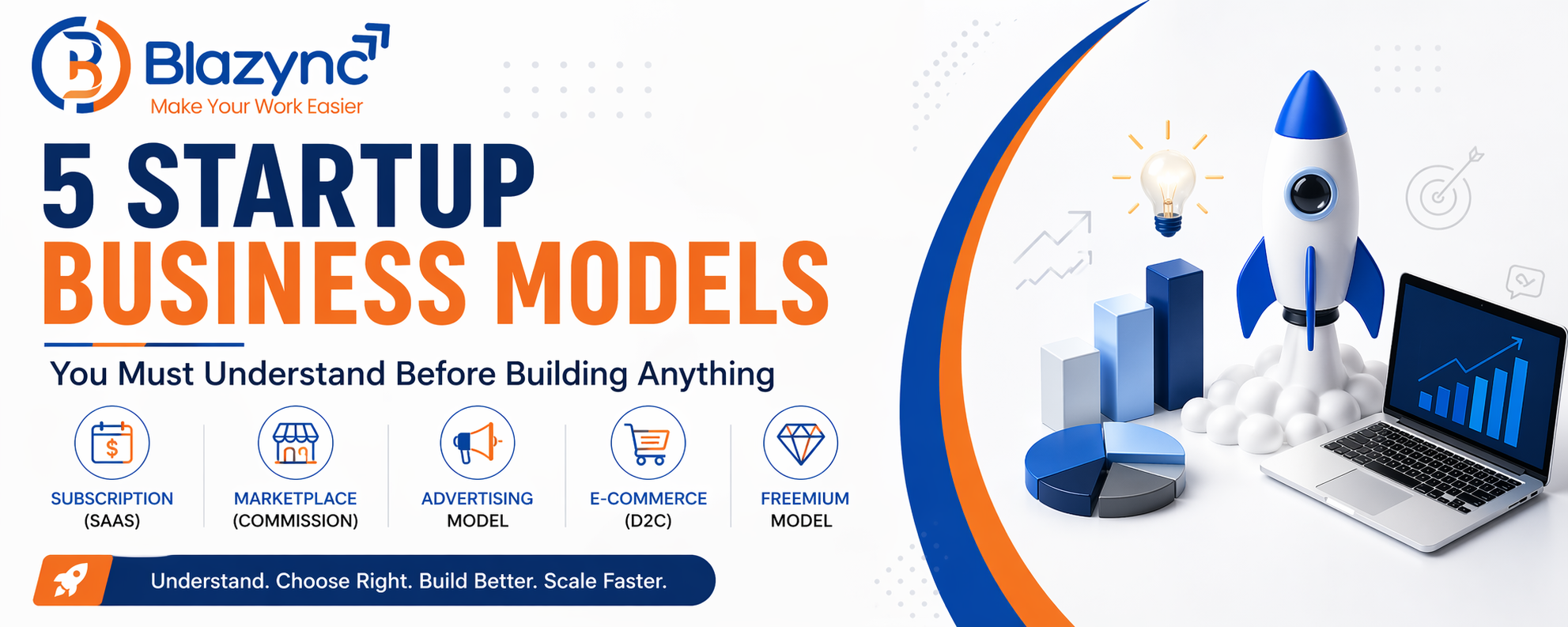
Everyone wants to build a startup. Very few understand how startups actually make money.
That gap is where most failures begin.
Founders spend months building features, designing dashboards, and polishing UI—without ever getting clear on one simple question:
How exactly will this business generate profit?
If you can’t answer that with precision, you’re not building a business—you’re building a gamble.
This article breaks down five common startup business models. But more importantly, it tells you where each one works, where it fails, and what most people get wrong.
1. Subscription Model (SaaS)
This is the most popular model today—especially among developers.
You charge users a monthly or yearly fee to access your product.
Examples: CRM tools, HRMS platforms, marketing automation software.
Why it looks attractive:
- Predictable recurring revenue
- Easier to scale over time
- High valuation potential
Where people go wrong:
Most founders think getting users is the hard part. It’s not.
Retention is the real game.
If users don’t stick, your business leaks money every single month. You keep acquiring users, but revenue never compounds.
Reality check:
If your product is not solving a painful, ongoing problem, subscription will fail.
2. Marketplace Model (Commission-Based)
You connect buyers and sellers, and take a cut from each transaction.
Examples: E-commerce platforms, service marketplaces, ride-sharing apps.
Why it looks attractive:
- Scales massively if it works
- No need to own inventory
- Strong network effects
Where people go wrong:
They underestimate the chicken-and-egg problem.
- No sellers → no buyers
- No buyers → no sellers
You need both at the same time, which usually requires:
- Heavy marketing spend
- Strong niche focus
- Or an unfair advantage
Reality check:
This is one of the hardest models to execute. Don’t touch it unless you have a clear entry strategy.
3. Advertising Model
You offer a free platform and make money through ads.
Examples: Social media platforms, content websites, search engines.
Why it looks attractive:
- Free product = easy user acquisition
- Monetization happens later
Where people go wrong:
They think traffic = money.
It doesn’t.
You need massive scale before ads generate meaningful revenue. Thousands of users won’t cut it. Even lakhs may not.
Reality check:
If you’re not building for millions of users, this model is practically useless.
4. E-commerce / Direct-to-Consumer (D2C)
You sell products directly to customers—online.
Examples: Clothing brands, electronics stores, niche product websites.
Why it looks attractive:
- Clear revenue model
- Direct control over pricing and branding
Where people go wrong:
They ignore operational complexity.
- Logistics
- Returns
- Customer support
- Inventory management
On top of that, customer acquisition costs are rising constantly.
Reality check:
Margins look good on paper. In practice, they shrink fast if you don’t control costs tightly.
5. Freemium Model
You offer a free version of your product, and charge for advanced features.
Examples: Productivity tools, SaaS platforms, design software.
Why it looks attractive:
- Low entry barrier
- Faster user growth
Where people go wrong:
They give away too much for free.
If users don’t feel a strong need to upgrade, your revenue never grows.
Reality check:
Freemium only works when:
- Users get real value quickly
- There is a clear, compelling reason to pay
What Actually Matters (And What Most Posts Ignore)
Understanding business models is step one. But it’s not enough.
Here’s what actually determines success:
1. Distribution
If you can’t get users, your model is irrelevant.
2. Unit Economics
You need to know:
- Customer Acquisition Cost (CAC)
- Lifetime Value (LTV)
If CAC > LTV, you don’t have a business.
3. Real Problem Solving
If your product is a “nice to have,” people won’t pay consistently.
The Only Question That Matters
Before building anything, ask this:
- Who is paying?
- Why are they paying?
- How often will they pay?
- What does it cost to acquire them?
If you can’t answer these clearly, stop building and fix the idea first.
Final Thoughts
Startup content online often simplifies things to make them look easy.
Reality is different.
Choosing the right business model doesn’t guarantee success—but choosing the wrong one almost guarantees failure.
Build less. Think more. Validate early.
That’s how real businesses are built.