
Development · May 15, 2025

Picture this: It is day one of your biggest festive flash sale. Your paid ads are converting like wildfire, traffic is spiking 8x, and revenue notifications are chiming every ten seconds.
Then, around 2:15 AM, disaster quietly strikes. A third-party webhook times out. Your no-code automation tool hits its monthly API execution limit without alerting you. The inventory sync between Shopify, your Amazon warehouse, and your ERP stalls. Within forty-five minutes, you have oversold 180 units of your flagship SKU that you do not actually have in stock.
Meanwhile, your customer support WhatsApp is flooded with 600 unread messages asking for order status updates, while your two human support agents are desperately copying tracking numbers from courier dashboards into spreadsheets.
This is the messy, unglamorous reality of scaling an eCommerce business. In 2026, AI automation is not about slapping an animated chat widget on your homepage that regurgitates FAQ bullet points. It is about operational plumbing — building an infrastructure that handles high velocity, prevents revenue leakage, and lets a lean team operate like a 50-person powerhouse.
When eCommerce brands decide to modernize their operations with AI, they usually fall into one of two traps:
At Blazync Technologies, our philosophy is rooted in reality: Use No-Code at the edges for speed and team autonomy, and Custom Code at the core for mission-critical reliability.
No-code and low-code platforms (like Make, n8n, Shopify Flow, Klaviyo AI, and Airtable) have evolved tremendously. If a workflow does not directly risk data corruption or high-concurrency race conditions, no-code is your fastest route to cash flow.
Instead of sending generic emails, modern no-code workflows can pass abandoned product details, user browsing history, and purchase probability to an LLM to generate hyper-personalized SMS or WhatsApp nudges tailored to the specific customer persona.
Connecting your store review app to an n8n pipeline allows you to automatically categorize incoming reviews. Positive reviews trigger instant social proof post generation, while negative reviews (1-2 stars) immediately open an urgent high-priority ticket in your CRM with an AI-drafted resolution plan.
Your marketing manager should not have to submit a developer ticket just to change a discount threshold or trigger an alert when a VIP customer spends over $500. No-code empowers non-technical team members to iterate at the speed of thought.
When money, inventory, and customer trust are on the line under high volume, no-code hits a hard wall. Here is where custom architecture and AI engineering pay for themselves ten times over:
Return fraud and Return-to-Origin (RTO) costs bleed eCommerce margins dry. We build custom vision verification pipelines: when a customer requests a return, our AI vision model inspects the uploaded image for barcode integrity, tags, signs of wear, and physical packaging condition in milliseconds. Legitimate claims get instant return label generation; suspicious items are automatically flagged for manual review.
If you sell across Shopify, Amazon, Quick Commerce (Blinkit, Zepto), and offline stores, maintaining a unified source of truth requires ACID-compliant database transactions and message queues (like Redis and BullMQ). A two-second latency in stock reconciliation during peak sales creates catastrophic overselling that no-code tools simply cannot handle reliably.
A true production AI commerce agent needs to perform safe, authenticated transactions: verifying customer identity, checking real-time warehouse inventory, updating Shopify draft orders, and sending interactive payment links with zero human intervention.
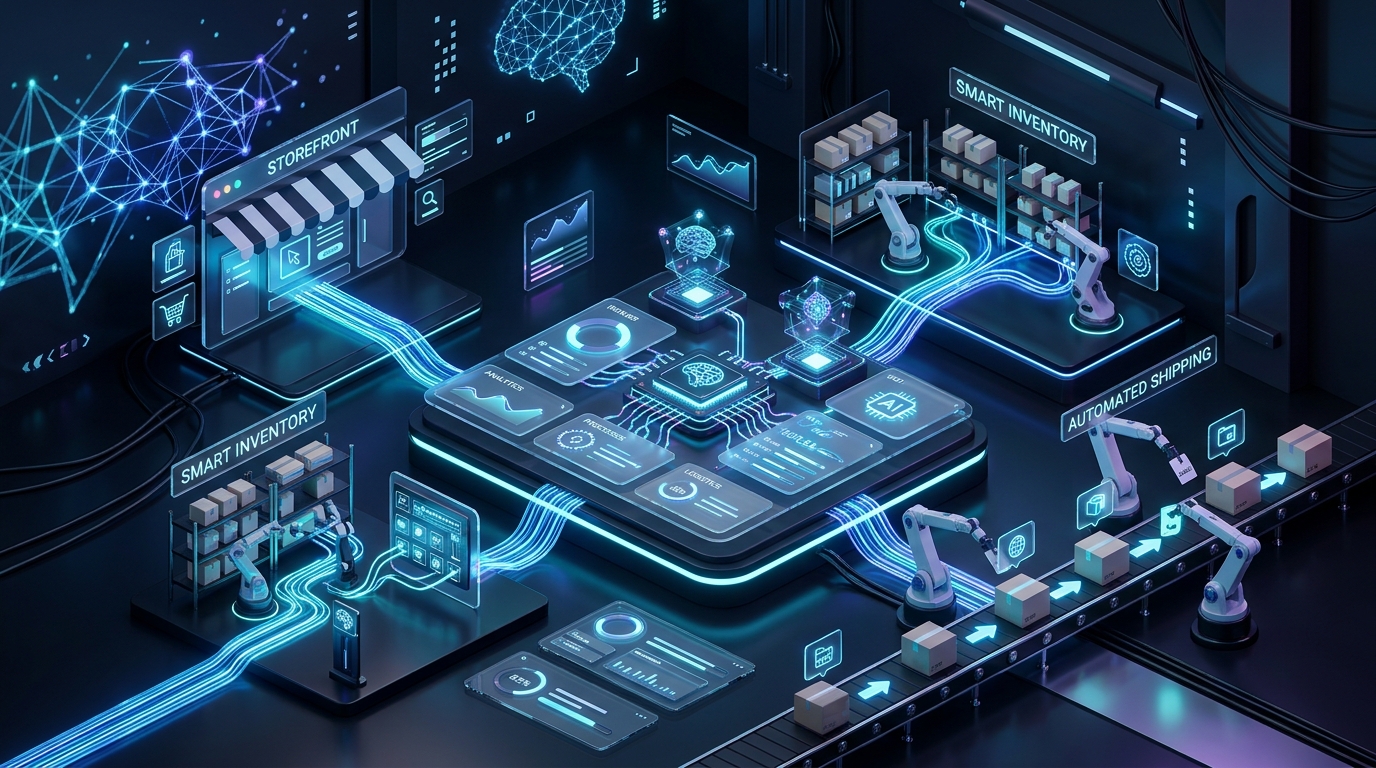
We structure your automation stack into three interconnected layers: 1. Agile Edge (No-Code) for marketing triggers and rapid experimentation; 2. Core Logic (Custom Code) for order routing, real-time inventory locking, and payment reconciliation; 3. Intelligent AI Layer for autonomous support agents, return triage, and purchase order parsing.
AI automation in eCommerce is not an all-or-nothing game. The fastest-growing D2C brands are the ones smart enough to combine both. Reach out to Blazync Technologies to map your automation architecture.